Men's jewelry: the complete guide to choosing wisely
Bracelets, necklaces, wedding bands, rings: a complete guide to men's jewelry. Materials, styles, how to pair them and how to choose with judgment. Everything you need to know.
There's a bias: jewelry is a woman's thing. Wrong. Men have worn jewelry in every culture, in every era. Egypt, Rome, the Renaissance, today.
The bias is recent, relative, geographic. Not cultural.
A men's jewel is not a secondary accessory. It's a statement. It says who you are. It says you pay attention. It says you know the difference between what's made well and what's mediocre.
This guide is for those who want to learn how to choose.
A brief history: men's jewelry through time
Ancient Egypt
Massive necklaces, elaborate bracelets, signet rings. Jewelry was power. Pharaohs, nobles, warriors wore it as a mark of status and divinity.
Nothing accessory about it.
Ancient Rome
Gold rings (on the index finger and the ring finger), chain necklaces, rigid bracelets. Rings were also symbols of rank: iron rings for citizens, gold rings for the elite.
A ring wasn't an ornament. It was a signature.
Italian Renaissance
Italian jewelry making explodes. Florence, Venice, Milan. Bracelets that look like sculptures, necklaces with weight, rings gleaming with rare stones.
It was the peak of men's jewelry as art.
Today
After a century of puritanism (the twentieth century and its 'simple' menswear), we're coming back. Slowly, consciously.
Contemporary men are discovering jewelry not as extravagance, but as a search for authenticity.
Categories of men's jewelry
Bracelets
The first step. The most emotionally accessible, the most versatile, the easiest to wear every day.
Rigid, link, or cord. In every material. It can be thin and discreet, or massive and present.
It's the jewel to start with.
If you're passionate about bracelets, don't miss our guide to choosing men's bracelets.
Necklaces and pendants
A necklace changes the meaning of the shoulder, the neck, the gesture. It's more demanding than a bracelet.
It can be a thin chain with a minimal pendant, or a thick, solid necklace. It requires confidence.
Rarely two necklaces together. Rarely a necklace without meaning (that is: either it's thin and invisible, or it's visible and it has to say something).
Wedding bands and rings
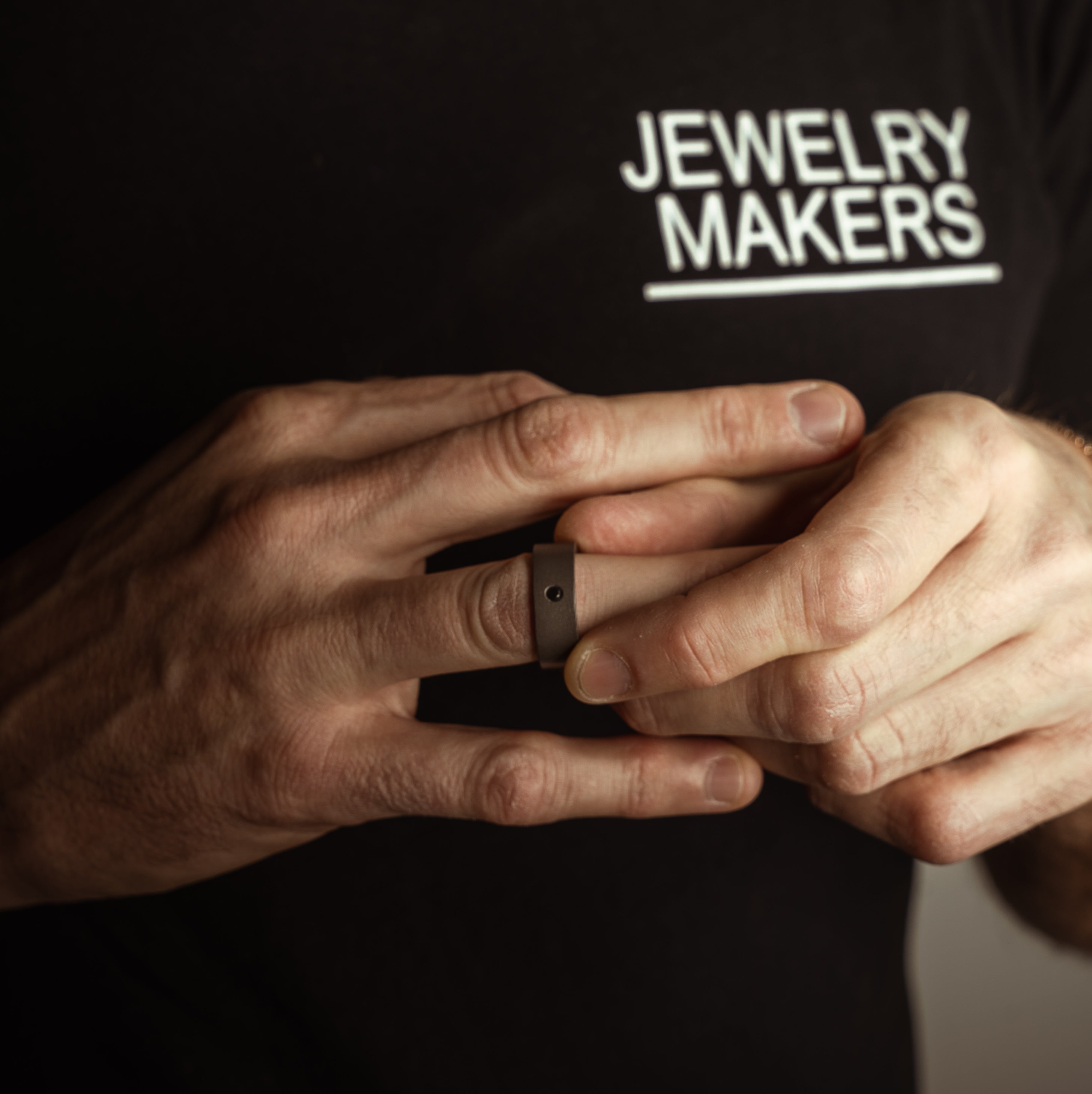
The ring is the most intimate jewel. It's on the finger. It's always visible to whoever shakes your hand. It's the first jewel noticed by those who know you well.
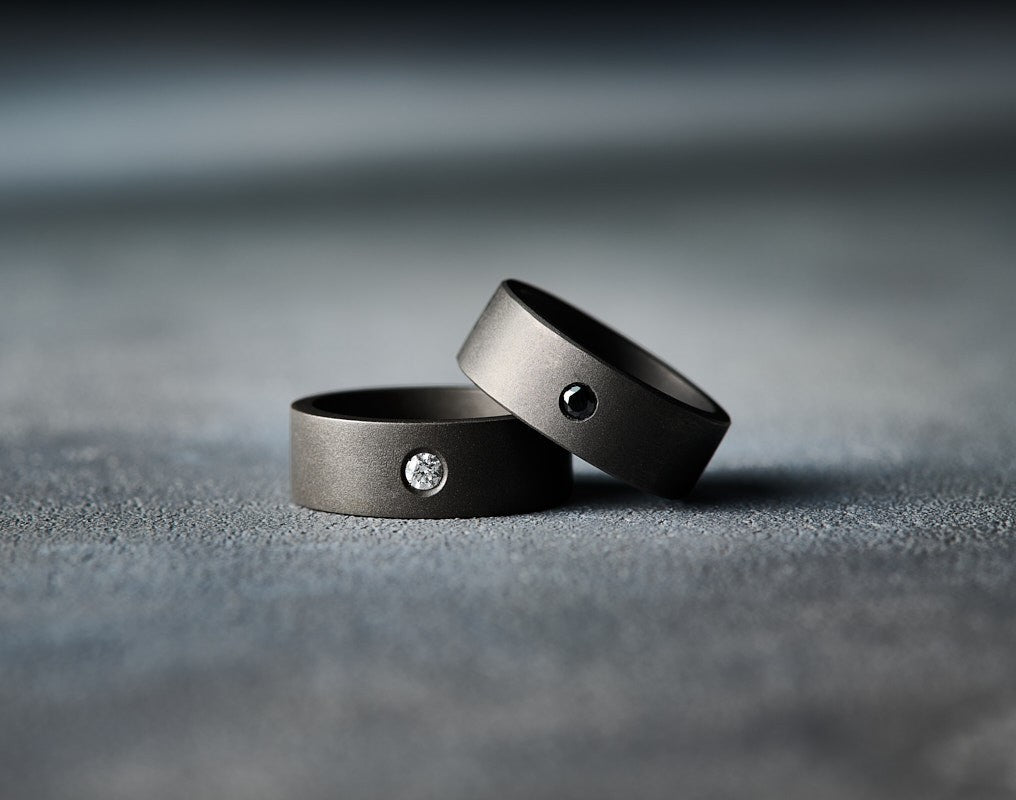
A ring can be minimalist (a thin band) or massive (a signet). It may have a stone, or not.
Generally one ring per hand (index finger, ring finger). Rarely more.
The wedding band is the ring loaded with meaning: marriage, promise, belonging.
Materials: how to choose with judgment
Titanium: lightness, durability, hypoallergenic
Characteristics:
• Weight: 40% lighter than steel
• Durability: resists oxidation, corrosion, scratches
• Biocompatibility: hypoallergenic, used in surgery
• Aesthetics: neutral gray, modern, sophisticated
It's the perfect material for those who want lightness without giving up solidity.
For those who want contemporaneity without making explicit statements.
A titanium bracelet, a titanium necklace, a titanium ring: these are choices of discreet elegance and performance.
Gold: 9 kt, 18 kt, yellow, white, red
Gold is the measure of preciousness.
9 kt (375 thousandths): 37.5% is pure gold. The rest is alloy (copper, silver). More resistant, more workable, ideal for men's jewelry worn every day.
18 kt (750 thousandths): 75% is pure gold. More precious, less resistant, ideal for occasions or for those who prefer intrinsic value.
Colors:
• Yellow gold: classic, traditional, warm. It's what you picture when you think of 'gold'.
• White gold: modern, cool, similar to platinum but less expensive.
• Red gold: Italian, warm, contemporary. It's not yellow, it's not white. It's the choice of brands with personality.
Choose gold if you want preciousness that lasts over time, intrinsic value, and the certainty that the jewel will always hold value.
Black diamonds
Diamonds are the choice for the jewel that has to shine. Black diamonds are a variant that has taken off in recent years: dramatic, modern, sophisticated color.
A black diamond on a red gold bracelet, or on a ring. It's the element that transforms the jewel from 'beautiful' to 'memorable'.
Steel and silver
Stainless steel is pure everyday wear: durable, easy to clean, affordable.
Silver is fascinating but fragile: it oxidizes over time, requires maintenance, and isn't suited to daily wear without care.
Choose steel if durability is the priority. Choose silver if aesthetics is the priority and you're willing to take care of the jewel.
How to pair men's jewelry (basic rules)
Rule 1: Consistency of weight
If you're wearing a massive bracelet, don't pair it with a thin necklace. If you're wearing a statement ring, the rest should be discreet.
One piece 'speaks', the rest 'supports'.
Rule 2: Consistency of metal
If you're wearing yellow gold, don't add steel. If you're wearing titanium (neutral gray), you can stay close to white and gray.
It's not rigid, but chromatic consistency is elegance.
Rule 3: Consistency of occasion
A formal jewel (heavy gold, diamonds) with a casual outfit (jeans, t-shirt) is a visual contrast. It works only if deliberate.
If you don't know what you're doing, keep consistency between jewel and outfit.
Rule 4: Less is more (usually)
A beautiful bracelet on the wrist is already a statement. Adding a necklace, two rings, an earring (rare, but it exists) is excess.
Choose one main element and let the rest be support.
Rule 5: Consistency of language
A minimalist jewel (titanium, clean line) with a heavy jewel (baroque gold, elaborate stones) sounds off.
Choose the tone: minimalist, or sumptuous. Don't mix the two languages.
The most common mistakes (and how to avoid them)
Mistake 1: Choosing by price, not by material
'I prefer titanium because it costs less.' Wrong. Choose titanium because you prefer lightness and modernity. Or choose gold because you want preciousness. Price is a consequence of the choice, not the guide.
How to avoid it: Ask yourself what you truly want (lightness? prestige? warmth?) and then choose the consistent material.
Mistake 2: Piling on jewelry
Three rings per hand, two bracelets, a necklace, an earring. It's confusion.
How to avoid it: One main element. One support. Stop.
Mistake 3: Elegant jewel with a neglected outfit
A gold ring on a crumpled t-shirt is dissonance.
How to avoid it: The jewel and the outfit must 'speak the same language'. If the outfit is casual, the jewel should be premium casual (titanium, contemporary design). If the outfit is elegant, the jewel can be more assertive.
Mistake 4: Forgetting maintenance
Gold gets covered in grime and loses its shine. Silver oxidizes. Titanium is nearly unalterable, but even it dulls when dirty.
How to avoid it: Clean the jewel regularly (lukewarm water, mild soap, soft cloth). For deep cleaning, trust a goldsmith every 6-12 months.
Handcrafted jewelry vs industrial jewelry: the difference you see and feel
Industrial jewel
Mass produced. Molds, CNC lathes, standardized processes. Every piece is identical to the last.
Advantages: low price, availability, consistency.
Disadvantages: no uniqueness. The hand of the craftsman is absent. If the design is mediocre, it's mediocre across thousands of identical copies.
Handcrafted jewel
Created by a craftsman. Every stage is manually controlled. Even if the base is mass produced, the finishing is unique.
Advantages: superior quality, uniqueness, a relationship with the maker. The jewel bears the imprint of the hand that made it.
Disadvantages: higher cost, variable timing, the need for real research to find the right craftsman.
How to recognize it: Look at the finish. Observe the proportions of the components. Feel the jewel (the weight, the comfort). Ask who made it. A true craftsman knows every detail of their work.
A quality handcrafted jewel costs more, but ages well. At 10 years, the comparison is night and day.
Made in Italy in jewelry: what it really means
'Made in Italy' in jewelry is a signature. It's not rhetoric.
Italy has the most refined goldsmith districts in the world: Vicenza, Arezzo, Florence. Centuries of tradition. Craftsmen who learn from their father, from their grandfather.
What true Made in Italy means:
• Italian design (the pursuit of forms, proportions, details)
• Certified materials (real gold, certified diamonds, medical-grade titanium)
• Manufactured in Italy (not 'designed in Italy, made in China')
• Manually controlled quality
• Traceability (you know where it was made, by whom, with what materials)
It's not a guarantee of low price. It's a guarantee of competence accumulated over time.
A MANO|J bracelet made in Italy isn't 'expensive because of the label'. It's made in Italy because the result requires that specific competence.
Frequently asked questions
Q: Can I wear gold and steel jewelry together?
A: Not ideal. Gold and steel have different tones (warm vs cool) and create dissonance. If one has to be present, the other should be minimal and invisible. Better to keep consistency: either all steel, or all gold (even in different shades: yellow, white, red).
Q: How many rings should I wear?
A: It depends on style and occasion. One ring per hand is elegant and not overdone. Two per hand, maximum. On a single hand, two rings are more credible than one on each hand. Avoid three or more per hand: it's excess.
Q: Does titanium have the same value as gold?
A: No, they have different values. Gold has intrinsic value (the weight of the precious metal). Titanium has value in the craftsmanship, in the rarity of the skilled workmanship, in performance. A titanium jewel is precious for different reasons.
Q: Why does men's jewelry cost so much if I wear it every day?
A: Because it's built for 'every day'. Materials that don't oxidize, workmanship that withstands impact, timeless design. Plus, handcrafted work takes time and rare skill. It's not expensive because it's a secret. It's expensive because it's made well.
Q: Can I wear a necklace under my t-shirt?
A: Yes, if it's thin and discreet. A minimalist chain with a small pendant is visually invisible, but you know it's there. It's intimate that way. If the necklace is heavy, it will show through the t-shirt: it should be decorative, not hidden.
Discover MANO|J
Discover the MANO|J collection of men's jewelry in titanium, red gold and black diamonds. Italian craftsmanship, premium materials, contemporary design.
Every jewel is chosen with awareness. As you should choose too.
Visit www.mano-j.it